
Breaking the Spell: Notes Toward a New Political Culture in St. Vincent and the Grenadines
After 24 years of political dominance, St. Vincent and the Grenadines experienced a decisive democratic rupture in the 2025 election. This essay reflects on the psychological unravelling of authoritarian governance and the opportunity now facing the nation: to rebuild civic life, decentralise power, strengthen ecological and food sovereignty, guard against foreign influence, and cultivate a political culture grounded in accountability, participation, and collective care.
This work is featured on “In the Diaspora” by Stabroek News.
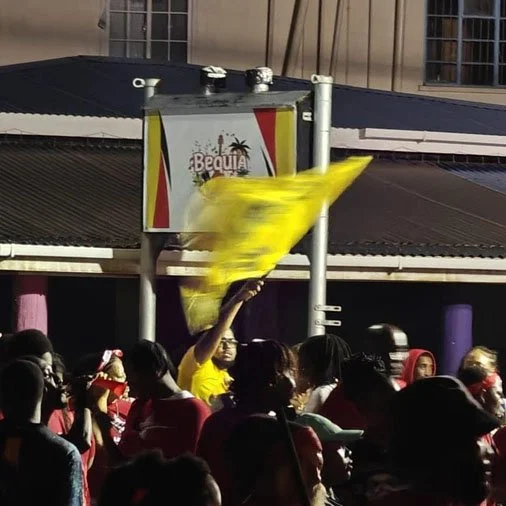
NDP supporter protesting at the final ULP rally in Port Elizabeth, Bequia, North Grenadines Constituency. Image courtesy Rick Gurley and Tiffany Phillips.
“The slopes to treachery from the dizzy heights of revolutionary leadership are always so steep and slippery that leaders, however well intentioned, can never build their fences too high”- C L R James, The Black Jacobins: Toussaint L'Ouverture and the San Domingo Revolution.
“Democracy doesn't recognise east or west; democracy is simply people's will.” Shirin Ebadi, Iranian Political Activist and Nobel Laureate.
The Breaking of a Political Spell
Two hours after the polls closed on Thursday, November 27th, 2025, something long dormant shifted in St. Vincent and the Grenadines. As a panel of analysts, pollsters and commentators discussed the unfolding results of the general election, a sense of possibility returned to a country that had grown accustomed to resignation. The tension in their voices, the pauses between each constituency result and the speculation circulating online signalled that a political spell twenty-four years in the making was fracturing in real time.
For nearly a quarter of a century, the Unity Labour Party (ULP) under Hon Dr Ralph Gonsalves exercised an extraordinary hold over the national imagination. It was not merely political dominance; it was psychological conditioning. The administration moulded Vincentians' understanding of their agency, narrowed their sense of the futures they could claim, and set limits on the aspirations they were permitted. Public confidence eroded. Dissent was punished. Civic participation became a partisan demand rather than a democratic right. Many felt the country had shrunk around them, economically, politically and imaginatively.
The 2025 general election brought that era to a decisive end. The New Democratic Party (NDP) secured nearly 10,000 more votes than the ULP and won 14 of 15 parliamentary seats, unseating every Labour candidate except Gonsalves himself. This was not a quiet transfer of power; it was a clear repudiation of an insulated and increasingly dynastic political project.
Across the country, the response was one of exhilaration. Vincentians described the lifting of a dark energy, a sudden ability to breathe after years of bureaucratic obstruction, political suppression and psychological fatigue. The election cracked through a long-festering malaise. It disrupted the sense that the state was more invested in policing and punishing than listening, that opportunity flowed through partisan gatekeeping rather than merit, and that the future was something dispensed from above. In the Grenadines, where decades of what geographer Ruth Wilson Gilmore calls “organised abandonment” had made many feel peripheral to the nation’s priorities, the shift was felt even more sharply. Gilmore uses the term to describe the deliberate withdrawal of public investment from specific communities, thereby creating the very conditions in which extraction and revenue-generating schemes rush in to fill the void left by weakened social infrastructure.
The swearing-in of Hon Dr Godwin Friday as the nation’s fifth Prime Minister marked an immediate change in tone. His early messaging has been earnest, measured and grounded in democratic humility. By inviting Vincentians to imagine a political culture shaped by listening, cooperation and respect for difference, he held up a mirror to a system long defined by exclusion. His posture signalled a stylistic turn and a structural opening toward treating the public as co-authors of national direction.
Rebuilding the Republic: Governance, Economy and Public Life
Nation-building now lies before the country as both an opportunity and an obligation. The work ahead requires confronting the legacies of the past twenty-four years: weakened local government, the lowest wages in the Organisation of Eastern Caribbean States (OECS), a debt-to-GDP ratio of 93.6 per cent, legislative stagnation, insufficient regulatory oversight, declining public trust and fragile food systems. Comprehensive audits will make plain the extent of institutional decay, and some findings will be uncomfortable. Nevertheless, the scale of the challenge highlights the urgency of coordinated action rather than diminishing the possibility of renewal.
One of the most important openings in this post-election moment is the revival of civic imagination, a capacity dulled by years of centralised authority. Vincentians are now insisting on their right to shape national priorities and demand more from institutions and from themselves. Across communities, questions are emerging about solidarity, responsibility and the ethical foundations of national life. The insistence on transparency and accountability marks a cultural turning point: a public no longer resigned to silence and political gatekeeping but prepared to challenge it.
Several areas require immediate focus. Food sovereignty and ecological resilience must become national priorities rather than policy ornaments. The fragility of our supply chains reflects long-term political neglect and new global realities. The incoming administration acknowledges that agriculture and the broader financial systems have weakened due to decades of uneven investment and extractive practices. Their manifesto gestures toward a political reorientation that treats access to land, environmental restoration, and climate-resilient livelihoods as the foundation of autonomy and economic self-determination. What remains to be seen is how this shift will reshape international partnerships, and how controversial tools like the Citizenship by Investment (CBI) programme, already fraught across the region, might be deployed within this new order.
Equally urgent is the rebuilding of local governance. A centralised state cannot serve an archipelagic nation whose social and economic life depends on inter-island mobility and responsive, community-led planning. Take, for example, the model currently in place under the Barbuda Local Government Act, which empowers the council to manage land, resources, and essential services on behalf of Barbudans. It demonstrates how decentralised authority can strengthen accountability and protect local priorities, ensuring that decision-making remains close to the people most affected.
Commitments to improved transport links, community health facilities and constituency-level development acknowledge the limits of the previous paradigm, though they stop short of naming the democratic deficit it produced. Infrastructure alone will not repair this deficit. Power, resources and decision-making authority must return to districts and islands so communities can set priorities and hold leaders accountable.
This is more than a technical adjustment; it is the democratic groundwork for a society that chooses to build with its people rather than rule over them. Innovation, entrepreneurship and social cohesion all rise or fall on the strength of governance closest to where people actually live and work. No economic strategy can be deep or durable unless it is grounded in local realities and shaped through genuine public participation.
Cultural, creative and healing initiatives must advance in parallel with structural repair. Grassroots organisations, creative collectives, youth initiatives, environmental NGOs, and mental health networks have long carried responsibilities the state neglected. These sectors now require more than symbolic recognition. They demand real policy support, equitable funding and long-term political commitment.
The transition from an entrenched government to a new administration is complex, and the challenges ahead will be significant. Constitutional reform is urgent, as is delivering genuine economic prospects for the public, who will not accept recycled rhetoric. Infrastructure remains battered; climate resilience demands serious investment; and democratic institutions have been strained by overreach. Repairing these failures requires a political culture that recognises citizens as partners and acts decisively to reform outdated structures and build new ones where necessary, as modelled in Barbados’ long-standing Social Partnership, where major national decisions require consultation and collective agreement, and much like Jamaica’s Parish Development Committees system, which embeds citizen voices into parish plans and local development priorities.
The country now stands on the precipice of possibility, fragile but promising. The end of this spell is not the end of the work; it is the beginning. The future will require courage, patience and honesty from both the incoming government and the public. It will require acknowledging the underdevelopment and institutional frailty inherited from the past and committing to repair. It will require imagining a nation not defined by fear or unquestioning loyalty but shaped by democratic principles.
Navigating New Pressures: Foreign Influence and Democratic Futures
This moment in St. Vincent and the Grenadines is unfolding alongside broader geopolitical shifts across the Caribbean. The inflation shocks of recent years have weakened long-standing incumbents and created openings for opposition parties, some of which appear unusually well-financed. This has intensified concerns about opaque funding streams (dark money) and the growing role of foreign capital in small-island elections. The pattern mirrors a broader imperial strategy in which political transitions often align with the interests of the United States, China, Japan and Europe, particularly around security, trade and foreign policy. Critics warn that such alignments represent a subtler form of neocolonial influence, shaping political outcomes during periods of economic vulnerability. Recognising this context does not diminish the significance of SVG’s transition; instead, it underscores the need for a political culture capable of negotiating external pressures while remaining accountable to its own people.
What this political moment offers, beyond a change of administration, is a chance to redefine political participation in St. Vincent and the Grenadines. The deeper question is not only what the new government will do, but what kind of political culture Vincentians are prepared to build. Suppose we want a culture rooted in transparency, mutual accountability and civic responsibility. In that case, we must insist on one where criticism is welcomed as a public good rather than condemned as disloyalty. We must nurture a society where principled disagreement strengthens the social contract. Looking out for one another must be understood as a political act and a collective ethic.
St. Vincent and the Grenadines is at the dawn of a new era, and the voting public has declared its intention to help shape it. Across the archipelago, people are reclaiming a sense of belonging and rejecting the idea that the nation must be endured rather than made. The imperative now is to channel this moment into a sustained culture of truth-telling and structural transformation. This includes constitutional reform that curbs executive overreach and embeds a more inclusive and horizontal, power-sharing model; a strengthened independent media; and the rebuilding of civil society networks that anchor solidarity beyond partisanship. It also calls for an education system that tells our history honestly, equipping young people to understand how power is organised and how it can be remade.
C. L. R. James’s epigraph in The Black Jacobins serves as a caution about the nature of power itself: even leaders who rise from noble struggle, he reminds us, stand on “dizzy heights” where the slope toward self-preserving treachery, authoritarianism, and betrayal can become dangerously slippery. That is the real work of liberation in this moment, not simply the end of a 24-year political era, but the clearing away of what no longer serves while actively building a political culture grounded in accountability, shared authority, and a renewed democratic process. With the spell broken, what follows will depend on whether Vincentians choose to turn this collective awakening into architecture strong enough to build the democratic future we have long imagined but were too often denied. Whether we remain vigilant of those dizzy heights James warned us never to trust.
See original posting at Stabroek News.