
Sanctuary After the Storm: A Toolkit of Repair Work for Caribbean Museums
Sanctuary After the Storm: A Toolkit of Repair Work for Caribbean Museums reflects on a co-creative psychosocial healing initiative piloted by the National Art Gallery of The Bahamas following Hurricane Dorian in 2019. Drawing on art therapy, community care, and ancestral healing practices, the initiative reached over 2,000 Bahamians and Haitians, 90% first-time visitors. The essay argues that Caribbean cultural institutions must centre care, interconnectedness, and community sovereignty as foundational acts of decolonial practice.
This paper was presented at the 47th ICOFOM Symposium in 2024, as part of an international convening on ecological museology, archipelagic heritage, and the role of museums and cultural institutions in responding to climate emergency and community care.
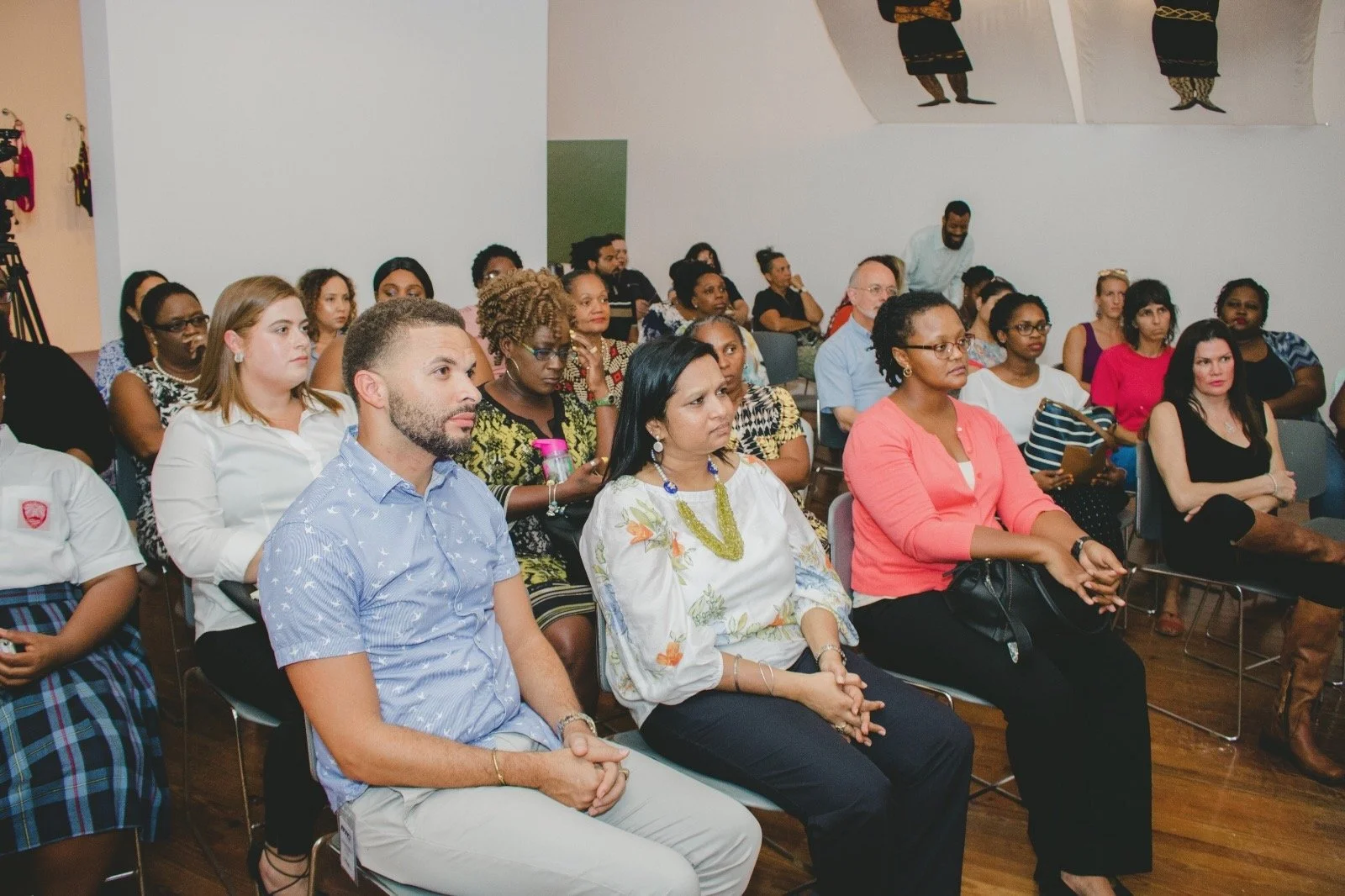
Mental health professionals, collaborators and professionals in the healing industry gather at the NAGB to discuss strategies of care. Image by Jackson Petit.
Introduction
This introduction foregrounds my experience as an ideator for Sanctuary After the Storm, a collaborative psychosocial healing initiative piloted by the National Art Gallery of The Bahamas (NAGB) in Nassau, New Providence during the aftermath of catastrophic Category 5 Hurricane Dorian in 2019. Community offerings and gatherings broke the spell of coloniality, the daze of cognitive dissonance, alienation, and ‘the cult of the individual’ that have endured and haunted the psychospiritual grounding of people across the Caribbean since the dawn of the transatlantic slave trade. Caribbean cultural institutions are tasked with listening deeply to their tangible and intangible environments to come to terms with the shifting needs of the human and more-than-human worlds in which they coexist. As stewards of heritage, culture, and memory, can they afford to look away from aspects of care, healing and rematriation that are essential components in the wake of the ‘permacrisis’ (Turnbull, 2022)?
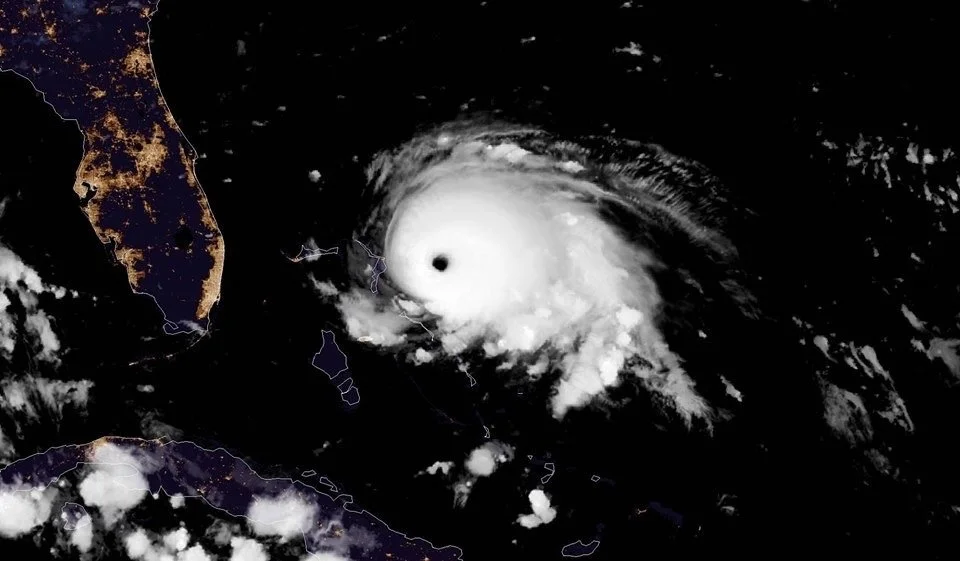
Hurricane Dorian is approaching the Abacos and Grand Bahama.
In Shallow Seas
During the last decade, there have been powerful upwellings of psychosocial, creative, and activist practices that are highlighting the need for urgent strategies across the Small Island Developing States of the Caribbean region as the public grapples with the gargantuan task of reparative justice and decolonisation while sitting on the frontlines of the climate injustice (Ferguson, 2019). Moving beyond what now seems like the social media trend of armchair activism, aspects of anti-colonialism and decolonisation are much like faith—without work and action, dead. If these neologisms are to function in a living and tangible way to mitigate and provide remediation possibilities for human and more-than-human worlds residing in low-lying archipelagic and very vulnerable island territories, then, indeed, collective action in all its iterations and wholeness must also upwell itself.
From the late 19th century until today, The Bahamas continues to be a testing ground for advancing the perimeters of the tourism product (Moore, 2019, p 4). Neo-colonial approaches and strategies within the financial, investment and tourism sectors have turned unsustainable with the exploitation and extraction of environmental resources and human capital, causing nationwide ecosystem precarity. The Bahamas continues to contend with the enduring vestiges of colonial machinery, and nowhere is this felt more than within the collective national psyche. Francophone philosophers Glissant and Fanon argue that the essence of colonisation disconnects people from their innate sense of self, from goodness, and self-determination (Glissant, 1997; Fanon, 1952). This reinforces the original wound of separateness, legitimising post-enlightenment values valorising the cult of the individual over the holding space of community.
The psychospiritual traumas of colonialism continue to be enduring, reproducing scaffolds of hyper-individualism and widespread (dis)ease. The challenge of decolonising the mind and arbitrating for aspects of care in institutions when neoliberal environments negate efforts such as introspecting, reflecting, healing, and connecting remains the crucial work at hand. Creating safe and brave spaces to explore elements of trust, mutuality, and care is the pioneering work ahead for Caribbean museums if they are to remain change-making, adaptable and ready to convene with the work of justice.
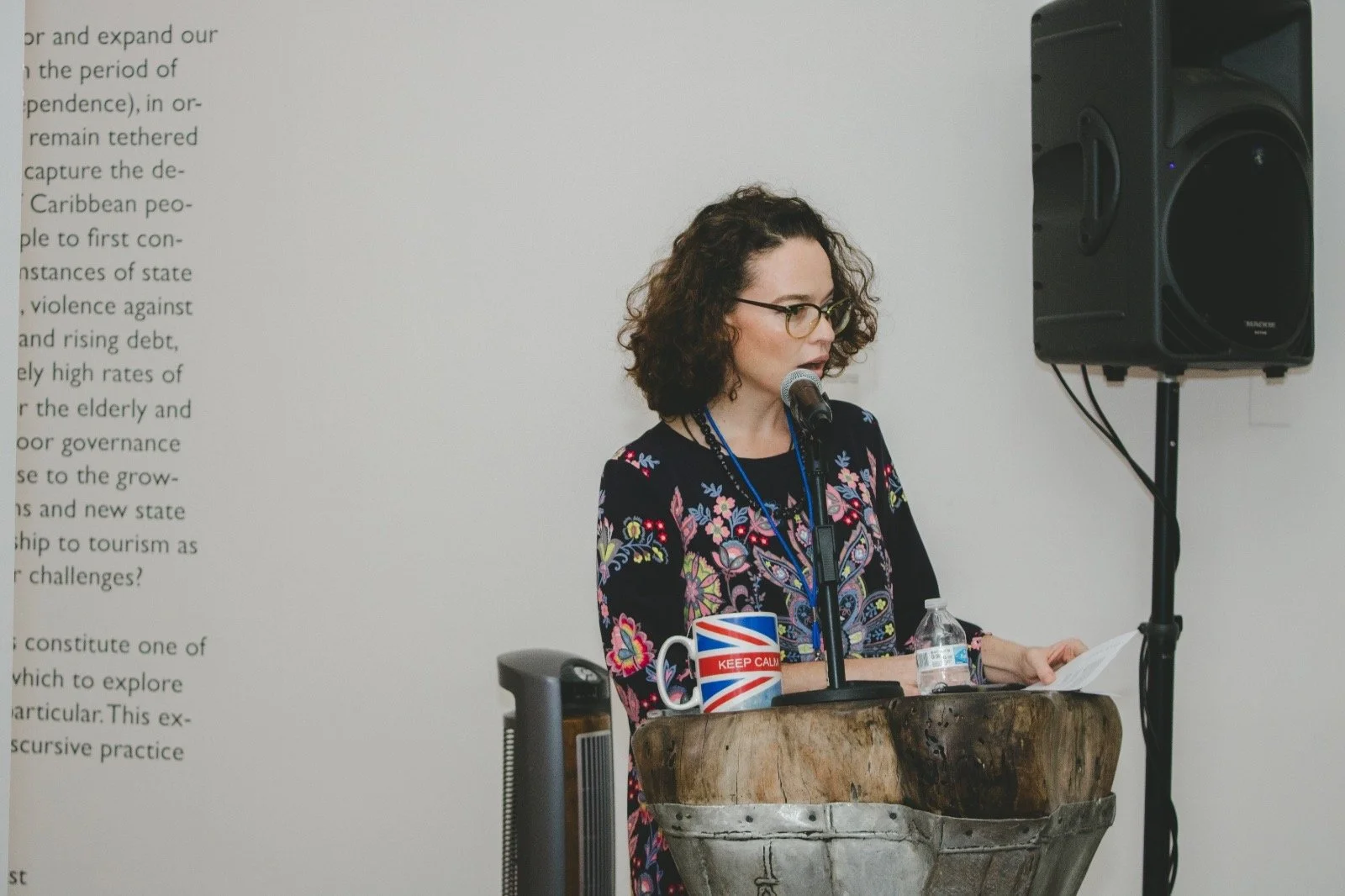
Sanctuary After the Storm
The NAGB was founded in 2003, and during its adolescent years faced many growing pains in its effort to designate itself as a safe and brave space to Bahamians living in its vicinity across the urban areas of downtown New Providence. Located on the border of the ‘nation’s navel’, the communities of Bain and Grants Town—historically significant political and revolutionary communities—double as two of the most underserved urban areas and remain challenged as social precarities continue to impact livelihoods. The surrounding communities saw the colonial architecture of Villa Doyle, felt its contested history, had living memories of it being private property, many concluding that the space was not made for them. This feeling of marginality and diminution felt by the communities was acute due to long standing colonial lines, classism, further impacted by gentrification and the overwhelming scar of tourism on the nation’s capital (Mayntz, 2024).
On September 1, 2019, Hurricane Dorian neared the Abacos and stalled over Grand Bahama for an unprecedented seventy-two hours with a whopping 185 mph winds. The slow-moving catastrophic system brought devastating surges up to 20 feet sweeping over swarths of cays, islets, and communities exacerbated by the ‘king tide’ (Avila et al, 2020, p 6). We watched persistent storm surge rip away homes, store fronts, vehicles, and cays as the live stories of climbing through attics and breaking down doors flooded in from artists across the Abacos. Together and almost immediately the staff of the NAGB casted a vote to care for their communities. Leaning into the cautionary tales of disaster capitalism, we devised a care campaign addressing mental health, wellness, and psychological dissociation across our shared island spaces.
Sanctuary After the Storm was a co-creative civic and healing psychosocial initiative developed to support New Providence-based communities and those affected in Grand Bahama and the Abacos, creating access to alternative modes of healing through art therapy, individual, family and community therapy sessions, public fora, wellness and meditation workshops along with more esoteric energy work brought forward by diasporic-based practitioners. The initiative highlighted the critical engagements that region-based institutions and Caribbean island nations struggle with while illuminating the need for care, love-centred modalities, intimacy and social mediation. In collaboration with Bahamian, regional and global communities of carers and healers, the institution was able to fund, produce, coordinate and co-facilitate a constellation of offerings to those impacted by a sense of belonging and normalcy, relief, and respite.
Seven social workers and mental health professionals were invited to lead the collaborative effort and facilitated with staff open forums to chart both urgent and short-term programs for the aftermath of recovery. Crisis management was offered to first responders with an emphasis on the Bahamas Defence Force; open therapy blocks for individuals and families were offered on site, at shelters and facilitated across the affected territories of Grand Bahama and the Abacos; several open mics and drumming nights were held for the displaced Haitian and Haitian-Bahamian youth from Abacos. The institution collaborated with artists, poets and griots, therapists, chefs, tour companies, the University of The Bahamas, and The Goodness Tour—a global collective of activists, muralists, artists, songwriters, and musicians—to amplify hopeful images and social programming across broken buildings and sites of unprocessed loss.
These were coupled with free Wellness Sunday sessions with mindfulness meditation and yoga along with programming specifically geared towards younger children. We worked with long time Grand Bahama resident, Scottish art therapist Susan Moir McKay, and the University of The Bahamas to devise a plan of care and recuperation for youth called ‘Create Space.’ The most surprising collaboration came in the form of Healing Hands Bahamas, a trio, headed by Bahamian poet and shamanic practitioner, Helen Klonaris. Exhibition galleries were transformed into healing rooms to facilitate the laying of hands, and over two weeks the team trained on-the-ground practitioners who had previous energy medicine skills to retool and accompany them to work across shelters. Their work culminated in a public lecture, compassionate listening circle, and a community workshop entitled ‘Imagining Refuge and Resiliency’ where the displaced, their families and others in need were able to be with their communities and feelings in a place of safety.
The NAGB’s visitorship comprised seventy to eighty percent foreign visitors, with local numbers growing sluggishly but steadily welcoming six to nine thousand people annually. 'Sanctuary After the Storm' programming ran for four months and impacted the lives of over 2000 Bahamians and Haitians, 90% of them never having entered the institution’s campus prior to these offerings.
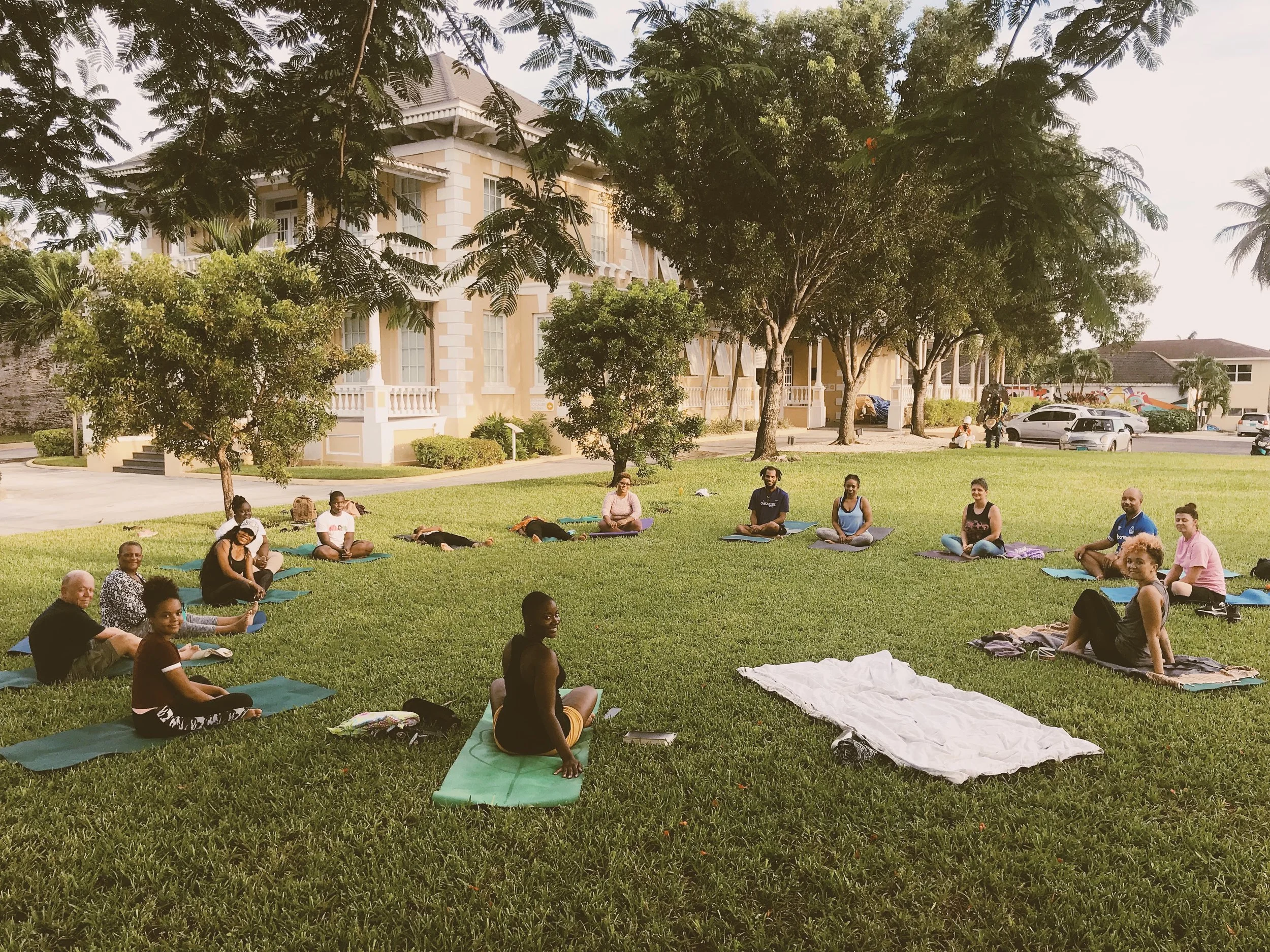
Yoga and somatic sessions offered to the Nassau community.
Conclusion: The Repair Work
What new knowledge did ‘Sanctuary After the Storm’ deliver to the institution for it to review its inner workings and ways of being? Firstly, be in context with your care: develop practical and theoretical engagements that rekindle old knowledge and skills to help communities reimagine their places, bodies, and minds as ‘climate change prepared.’ A part of, rather than apart from.
Honour Interconnectedness: recognizing the interrelation of the human and more-than-human world will revitalise learning systems. Think about the ecosystem of relationality and the space of the museum like the deep floor of the ocean, where there are thousands of not-yet-discovered species with elevated consciousness that we can build mutuality with. Nurture the unity in the submarine (Brathwaite, 1975).
Rest: think about the institution like fallow land - know when it is rewilding, when new species and ideas are emerging, what is of benefit or of threat. Without time to observe what is present you might be ploughing over fertile seeds of deeper care and decolonisation. Breed Polycultures: work to heal the severed relationships with disparate local communities, collectives, and agents of care. Sit with the discomfort and trouble of unknowing and being challenged. Nourish and welcome the death cycle: the role of stewards within an ecosystem, to be composters nurturing generational cycles of livingness, ideation, and play.
Inviting communities to participate, build and take ownership in non-transactional, mutual, and experimental ways ensured that the public’s needs were heard, actioned on and integrated. This was essential to the widespread success of the venture, where the institution took the risk of paving the way for strategies of decolonisation like care, embodiment, and justice to move without entrapment, dramatically shifting its relationship to the urgent realities and sombre deficits made visible by the climate emergency. Perhaps, cunningly revealing the hubris of being unsinkable on a hill surrounded by shallow seas.
REFERENCES
Avila, Lixion A, et al. (2020, April 20). Tropical Cyclone Report Hurricane Dorian, 24 August - 7 September 2019. National Hurricane Center. https://www.nhc.noaa.gov/data/tcr/AL052019_Dorian.pdf
Brathwaite, E. K. (1975, September). Caribbean Man in Space and Time. Savacou, Volume11-12: 1-11.
Fanon, F. (1952). Black Skin, White Masks. New York: Grove Press.
Ferguson, B. (2019, September 12). Hurricane Dorian Was A Climate Injustice. The New Yorker. https://www.newyorker.com/news/news-desk/hurricane-dorian-was-a-climate-injustice.
Glissant, É. (1997). Poetics of Relation. Ann Arbor: University of Michigan Press.
Mayntz, M. (2024, January 8). Cruise Port in the Bahamas Shatters Annual Passenger Record. Cruise Hive. https://www.cruisehive.com/cruise-port-in-the-bahamas-shatters-annual-passenger-record/120283
Moore, A. (2019). Destination Anthropocene: Science and Tourism in The Bahamas (1st ed., Vol. 7). University of California Press.
Turnbull, N. (2022, November 11). Permacrisis: what it means and why it’s word of the year for 2022. The Conversation. https://theconversation.com/permacrisis-what-it-means-and-why-its-word-of-the-year-for-2022-194306